Imagine making a hit movie. You need a great director, a daring stunt team, and a doctor on set. A Youth Wellness Night works the same way.
This isn’t just about checking boxes. It’s about teamwork between the PTA, coaches, and local clinics.
The CDC says 37% of high school students struggle with their mental health. And 44% feel sad all the time.
But there’s hope. Students who feel close to adults and friends at school are much happier. This connection is key.
This isn’t just about having fun. It’s a call to action. We need these groups to work together.
The goal is to turn a school gym from a place of fear into a place of holistic health. Let’s see how this wellness community is built.
Rotating Stations: The Choose-Your-Own-Adventure Guide to Teen Health
Let’s face it, lectures on sleep can be boring. The rotating station model changes that. It turns teen health education into a fun, interactive experience. It’s perfect for today’s teens who love quick, engaging content.
We focus on four key areas: Sleep, Screen Time, Nutrition, and Mental Health. Each station is a self-contained, interactive module. Teens can explore at their own pace, making self-care a fun adventure.
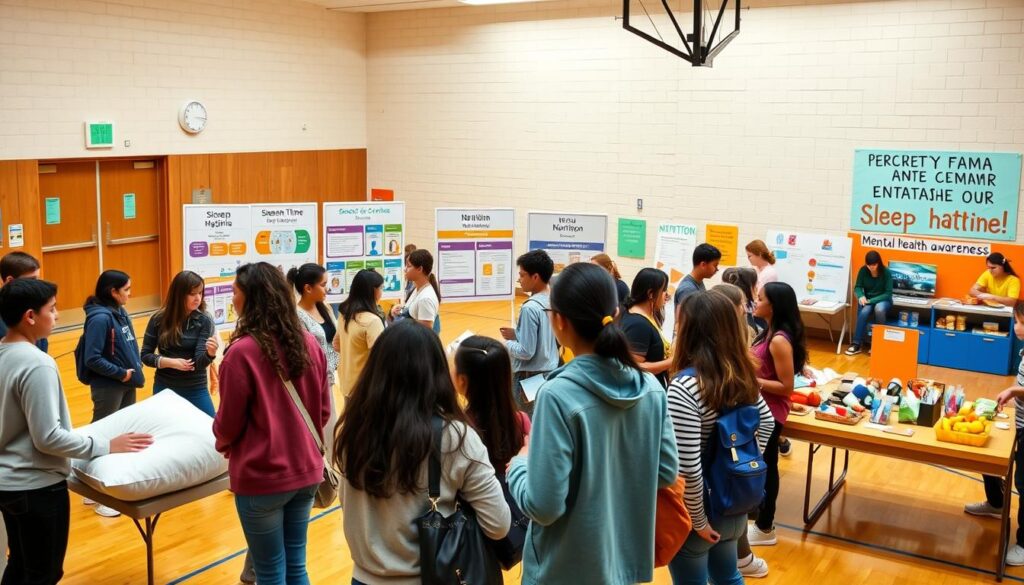
The Sleep Station is a place where tech takes a backseat. We use science to show why kids need 9-11 hours of sleep. It’s about showing how blue light filters and bedtime routines can improve sleep, not just telling.
The Screen Time Station is a bit sarcastic. It shows that less than two hours of screen time is best. The “Scroll Meter” challenge makes this clear. It shows how too much screen time can harm physical activity.
The Nutrition Station is more than just about eating healthy. It uses Canada’s Food Guide to make learning about food fun. Activities like a “Blindfolded Veggie Taste Test” and a “Smoothie Bike Blender” make healthy food exciting.
The Mental Health Station makes talking about feelings normal. It shows how stress can affect health. Tools like emoji check-in boards help teens express their feelings easily. It’s a way to show that mental health is important.
| Station Focus | Core Data & Guideline | The Interactive Hook |
|---|---|---|
| Sleep Sanctuary | 9-11 hours per night for ages 5-17. | Tech-amnesty zone & personalized bedtime routine builder. |
| Screen Time Lab | Less than 2 hours of recreational use daily. | “Scroll Meter” challenge visualizing use vs. physical activity. |
| Nutrition Hub | Nutritious food based on national food guides fuels learning. | Blindfolded taste tests & smoothie bike blender activities. |
| Mental Health Check-In | Stress signals: headaches, sleep issues, behavior changes. | Emoji check-in boards and non-verbal vocabulary tools. |
This model is more than just fun. It’s a smart way to teach teens about health. By making data fun and interactive, we help teens understand important health tips. It’s a great way to teach youth wellness initiatives in a modern way.
Sports Skills + Mindfulness Corners
Imagine learning to make a layup and calm down at the same time. This is what happens when sports and mindfulness come together. We’re ending the old fight between athletes and meditators. Today’s students need skills for both their bodies and minds.
The Sports Skills Corner is not just for sports teams. It’s about learning basic movements. We teach how to fall safely and understand the science behind jumping. It also covers teamwork and fair play.
The Mindfulness Corner is not just sitting quietly. It’s about using your body to relax. Yoga teacher Jai Sugrim says it’s like having a special tool to calm down.
We use fun activities to teach mindfulness. Kids learn to breathe like a rainbow and check their surroundings. These exercises help them relax and focus.
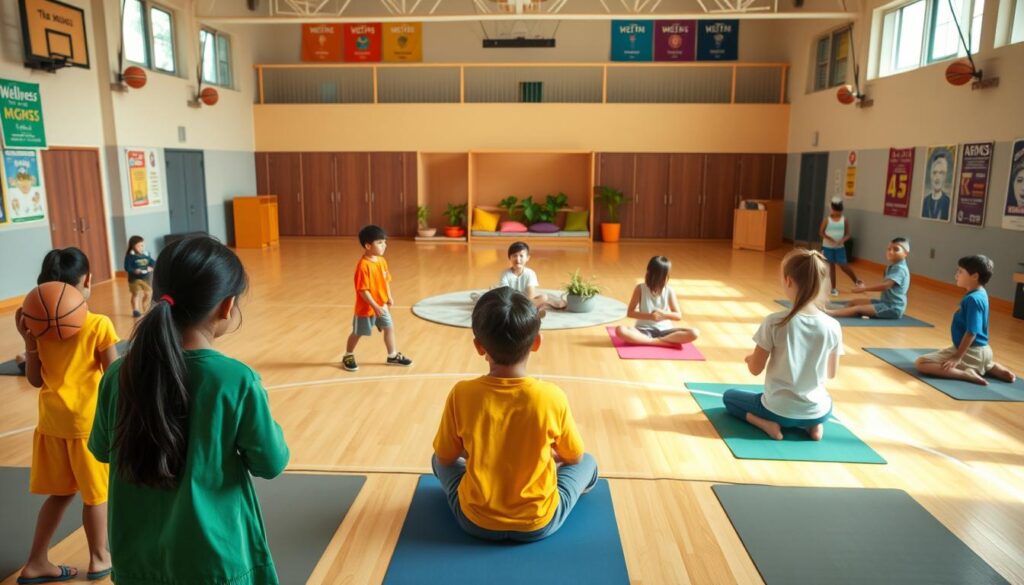
So, how do throwing a ball and breathing like a rainbow connect? One corner teaches us about our bodies and how they work. The other helps us manage our thoughts and feelings. Learning one helps us feel more confident in the other.
Let’s look at how these corners help students grow:
| Corner | Core Activity | Key SEL Skill Developed | Direct Benefit |
|---|---|---|---|
| Sports Skills | Fundamental Movement (e.g., safe falling, jump mechanics) | Self-Management & Relationship Skills | Builds physical confidence, teaches fair play, enhances coordination |
| Mindfulness | Active Neuro-Hacking (e.g., Rainbow Breath, Five Senses Check-In) | Self-Awareness & Self-Regulation | Reduces acute stress, improves focus, provides emotional coping tools |
| Integrated Effect | Applying mindful focus to physical tasks & using body awareness to ground the mind | Resilience & Responsible Decision-Making | Creates a feedback loop of control; calmness improves performance, physical success boosts mental well-being |
This table shows how to build resilience. It’s about learning to handle challenges, whether on the court or in school. The activities here are designed to help students succeed in all areas of life.
We’re not picking between sports and mindfulness. We’re creating a new kind of person. This person is strong, aware, and ready for anything. The skills learned here are the foundation for this transformation.
Parent Education Breakouts
Modern parents face a unique exhaustion: wellness fatigue. They’re overwhelmed by advice on sleep, screens, and sugar. The Parent Education Breakout is a lifeline.
Think of it as your backstage pass. It shifts from “what my kid did tonight” to “how we can be a team tomorrow.” It blends intellectual analysis with real-life challenges.
Children learn best when parents are involved. But it’s not just about showing up. It’s about creating a culture where school wellness principles are followed at home. How do you enforce screen time limits without conflict? What does a “cool, dark, and quiet” sleep environment look like in a shared bedroom?
Let’s turn the night’s themes into home practices. We’ll discuss the irony of teaching nutrition while hiding in the pantry. The goal is to offer guidance, not judgment.
Here’s a practical guide based on evidence:
- Walk the Talk (Literally): Involve kids in meal prep. It’s not about being perfect. It’s about making meal prep a conversation. This builds lasting habits.
- The Bedtime Algorithm: Focus on establishing a sleep routine. It’s about consistent cues, not strict clocks. Read together and practice gratitude. This signals the brain to wind down.
- From Surveillance to Partnership: Create a family media plan instead of just setting timers. Have a charging station outside bedrooms. This shifts your role from cop to coach.
- Volunteer Smarter: If you can’t help in class, ask the teacher for a specific task. This shows your kid that school wellness is a shared priority.
The aim is to create family rituals that feel natural. It’s about integrating health into your daily life. Walking to school together is more than commuting. It’s about connecting and modeling activity.
This breakout cuts through the noise. It provides the how behind the what. Without this bridge, even the best school programs are just that. With it, you build a team. And that’s where real, sustainable school wellness starts.
Consent/Privacy Steps
Permission slips are like the kindergarten version of consent. For a teen health event, we need something more. We need a system that respects the mind and keeps everyone safe. It’s not just about filling out forms.
This system is built on informed consent. It lets students choose what they want to do or not do. They can skip the mindfulness corner or the nutrition quiz without feeling judged. Any data from a wellness survey is handled carefully and then destroyed.
Our privacy policy shows our commitment to this. We follow clear, factual models like the Toronto Public Health framework. It makes the conversation about safety and respect clear and simple.
- Using correct names for body parts isn’t clinical; it’s precise.
- Everyone has the right to say “no” to any touch or activity—full stop.
- Touch or conversations that feel uncomfortable are never a secret.
- A trusted adult is always the next step.
This framework shapes the whole event. It makes sure there are private spaces for talks with counselors or nurses. It also trains staff to support teens, not just perform care.
This approach is honest and direct. We’re not promising magic. We’re building trust by being open and clear. This makes wellness for teens real and meaningful.
When safety is clear, the fun at other stations feels real. The sports drills, smoothie blenders, and sleep tips all stand on this foundation. It’s what lets real learning and teen health progress start.
Attendance Incentives and Follow‑Up
The pizza is gone, and the stations are packed away. Now, the real test starts. Anyone can throw a party, but creating a lasting movement takes follow-through.
Effective incentives use behavioral economics, not just bribery. A station passport for SEL activities, recognition for family attendance—these small rewards build habits. The key is in the follow-up. A check-in two weeks later asks about lasting habits. A shared online folder supports families, and a student-led Wellness Committee keeps the momentum.
Consistency is key. One-off events don’t last without ongoing support. Integrated models, like School-Based Health Centers, show the power of structured follow-up. A study on integrated care models found that coordinated follow-up boosts continuity. This turns a single night into a cycle of care.
The final measure isn’t just a one-night spike. It’s the gradual increase in a school’s cultural wellbeing. This process builds the “school connectedness” the CDC calls our ultimate teen mental health shield. Real change is a slow burn, fueled by smart incentives and relentless follow-up.