Our culture is really bad at dealing with loss. We see grief as a private issue, like a software bug fixed alone at 3 AM.
But what if we’re wrong? Grieving together is not just about one person. It’s about the messy, human act of sharing our sorrow.
Did you know that 6.4 million U.S. children lose a parent or sibling by 18? It’s not just individual tragedies. It’s a public health crisis that needs a shared response.
The Dinner Party says, “Your grief is yours alone, but that doesn’t mean you need to be alone in your grieving.” Places like Judi’s House agree, saying no child should face this alone.
So, we ask: How do we build a shared understanding when everything feels lost?
Benefits of Group Settings
The magic of grief support groups lies in sharing feelings without judgment. The Dinner Party says, “grief isn’t a problem to fix, but the loneliness it brings.” These groups offer a place where everyone understands the theme of loss.
So, why join what seems like the saddest club? It’s because you can be yourself without pretending. Inside, you can admit you’re lost without feeling judged.
Let’s look at the real benefits of these support networks.
First, you hear your thoughts echoed by others. This makes you feel less alone. You realize you’re not crazy for feeling this way.
Then, you get practical advice from those who’ve been there. They share tips on dealing with everyday challenges. This advice is invaluable.
Another benefit is the chance to laugh together. Dark humor that might shock others feels right in these groups. It’s a way to find joy in hard times.
Groups like Judi’s House create a safe space for healing. They help families and individuals find support together. This creates a strong community.
Think of these groups as a research team. Everyone is learning and sharing how to cope with loss. You see different ways of dealing with grief, which helps you understand your own journey.
The biggest benefit is seeing your humanity reflected in others. These groups show you’re not alone in your feelings. They offer a space of understanding and connection.
Types of Grief Support Groups
Forget the old idea of a dull support group. Today, grief support is as varied as movies on streaming services. You’re not just looking for any group; you’re searching for the one that fits you.
Let’s explore the options. On one side, you have groups led by therapists, like FamilyMeans. They offer structured guidance and a professional approach. It’s like grief school.
On the other side, there are groups led by peers. Think of The Dinner Party’s “Tables,” which meet in-person and online. These are places where people share their experiences, not seek advice. It’s about connecting with others who understand.
Then, there are groups for specific losses or identities. These include groups for those who’ve lost someone to suicide, young widows, or LGBTQ+ individuals. The Dinner Party highlights these “affinity spaces.” Here, you can skip explaining your pain because others share your experience.
| Type | Best For | Environment | Key Driver |
|---|---|---|---|
| Therapist-Facilitated | Those seeking structured, guided processing and clinical insight. | Formal, often hosted by counseling centers or hospitals. | Professional expertise and psychological safety. |
| Peer-Led | Individuals craving authentic connection and shared storytelling. | Informal, hosted in homes, community centers, or online. | Mutual understanding and lived experience. |
| Affinity-Based | Grievers with a specific loss type or identity who want immediate relatability. | Varies, but focused on a common, defining experience. | Shared identity, which reduces the need to “translate” your grief. |
The best grief support happens when you don’t have to explain your loss. In a generic group, you spend time explaining your story. But in a group that understands you, you can just share.
Finding a strong support network is key. The right place validates your experience without asking you to justify it. Whether it’s a professional program, a peer group, or a group for your specific loss, the goal is the same. Find a place where your story is already understood.
Child & Teen Grief Programs
Grief in kids shows up in different ways than in adults. It might look like not wanting to eat or focusing too much on one thing. Kids act out their grief through play and behavior changes.

Did you know 6.4 million American kids will lose a parent or sibling before 18? This is a big problem that needs attention. Without grief support, kids face many challenges like school problems and health issues.
Judi’s House offers a special approach to help kids. They believe no child should face grief alone. Jenna, who lost her brother, found support at Judi’s House. She connected with others who understood her grief.
What makes these programs effective? They speak the language of grief:
- Play-based therapy: Kids might build and destroy things to deal with their feelings.
- Art and storytelling: Painting and telling stories help make sense of difficult emotions.
- Peer groups for teens: Teens find support in groups where everyone understands their loss.
For teens, being part of a group is key. Their brains are already changing a lot. Grief adds to the mix. Peer support groups offer a special kind of understanding.
These programs are like early medicine for the soul. They help kids build resilience instead of letting grief become a lasting burden. It’s cheaper and better for their emotional and financial health.
Special grief support for young people helps them cope with loss. It’s not just therapy; it’s teaching them to live with grief. This is essential life skills for facing the toughest realities.
When to Seek Additional Help
Imagine your grief as a complex math problem that needs calculus, but you only know algebra. That’s when you need more help. Your grief support group is great for sharing and comfort, but it can’t solve all your problems.
Here’s the truth from the Sage archetype. Group settings offer important support networks, but they’re not enough. Sometimes, bereavement mixes with depression, anxiety, or trauma that needs a pro to untangle. Grief and depression can look the same, making it hard to tell them apart.
So, how do you tell them apart? We’ll use a special tool, without the lab coat.
| Aspect | Normal Grief Response | Clinical Depression |
|---|---|---|
| Emotional Pattern | Waves of sadness with moments of relief or connection | A flat, persistent low mood like emotional concrete |
| Response to Support | Finds some comfort in sharing and group connection | Feels numb or disconnected even in supportive settings |
| Self-Care | Basic routines suffer but aren’t completely abandoned | Personal hygiene, eating, sleeping are severely disrupted |
| Time Perspective | Can imagine a future, even if it’s hazy and different | Future feels permanently void, hopeless, or nonexistent |
| Pleasure Capacity | Can experience fleeting moments of joy or humor | Anhedonia—inability to feel pleasure from anything |
Look at the main differences. It’s about how much room you have for joy, even small moments. Has your self-care been gone for too long? Most importantly, are you thinking of harming yourself?
Grief is like a stormy season—tough, unpredictable, but short. Depression is like a permanent change in the weather. It changes everything.
Getting a therapist isn’t a sign of failure. It’s like calling in a specialist when you hit a problem you can’t solve. You need someone with the right tools.
Therapists offer things groups can’t: special techniques, help with trauma, and medication if needed. Your grief support group gives you community. A therapist gives you a plan just for you.
If the table shows too many signs of depression, it’s time to act. FamilyMeans experts say: “Connect with our Center for Grief & Loss team to learn more and schedule an appointment.” This step is not giving up. It’s upgrading your tools for the toughest parts of your journey.
Remember, asking for more help shows you’re serious about your grief. That’s not weak—it’s honest.
Creating Supportive Rituals
Rituals offer a radical thing in the chaos of loss: small, repeatable moments of intention. They stand against grief’s overwhelming spread. Think of them as deliberate punctuation in what feels like a never-ending run-on sentence.
Rituals often get a bad rap. They might seem too religious or like something from a wellness influencer’s Instagram. But, when you strip away the baggage, you find a simple, powerful tool: meaningful action, repeated with purpose.
This isn’t about grand, public ceremonies. We’re talking about micro-rituals—the tiny, personal acts that create structure when everything feels structureless. The weekly coffee where you’re allowed to mention their name without awkwardness. The specific playlist you listen to on difficult anniversaries.
Even showing up to a grief support group is itself a ritual. You mark the time, you go to the place, you participate in the shared practice of listening. It’s a collective agreement to hold space. These acts become lifelines in an emotional riptide.
So why do they work? Rituals create pockets of control in a universe that feels uncontrollable. When the big picture is terrifying, you focus on the small action you can manage. Lighting that candle. Writing that one sentence in a journal. It’s emotional judo—using grief’s own weight against it.
| Ritual Type | Frequency | Primary Purpose | Example Action |
|---|---|---|---|
| Connection Ritual | Weekly/Bi-weekly | Maintain social bonds, combat isolation | “Grief coffee” with a trusted friend |
| Memorial Ritual | Monthly/Annually | Honor memory, mark passage of time | Visit a meaningful place on specific dates |
| Personal Reflection | Daily/As needed | Process emotions privately | Morning journaling for 10 minutes |
| Collective Support | Regular schedule | Share burden, gain perspective | Attending scheduled support group meetings |
Notice how these aren’t complicated. The simpler, the better. Complexity is the enemy of consistency when you’re grieving. A ritual should be so straightforward you can do it on your worst day. That’s its superpower.
These practices also externalize internal chaos. Grief lives in your head as a swirling mess of thoughts and feelings. A ritual gives it a shape, a time, a place. You’re literally taking the intangible and making it tangible. It’s alchemy for the emotionally bankrupt.
The key is intentionality. Anyone can go through motions. The magic happens when you infuse the action with meaning. That weekly walk isn’t just exercise—it’s your time to remember, to feel, to process. The difference is everything.
For deeper exploration of this concept, consider reading about creating rituals to move through grief. The article breaks down how intentional practices can guide emotional navigation.
Ultimately, supportive rituals rebuild your internal architecture. Loss can feel like an earthquake that leveled your emotional home. These small, repeated acts are the first bricks in reconstruction. They’re not the whole house, but they’re a damn good foundation.
Family Communication During Loss
Imagine a family in grief as a group without a leader. Each member feels and expresses their pain in different ways. Some speak openly, others stay silent, and some quietly seethe with anger.
The dream is that everyone mourns together. But the reality is more like a diplomatic crisis at home. The goal is not to be the same. It’s to understand each other.
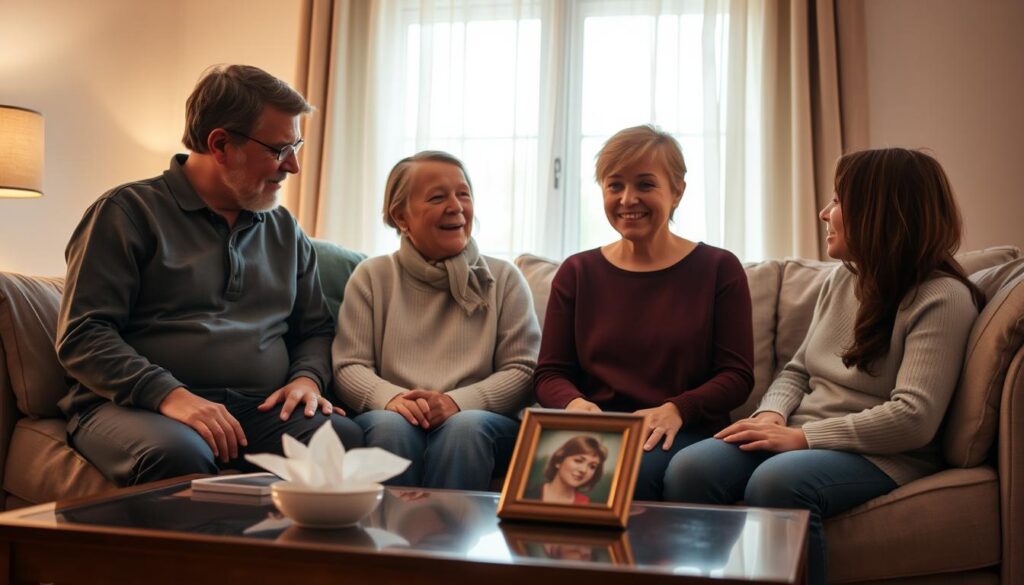
How does a parent who keeps going understand a child who needs to cry? How does a teenager full of anger connect with a sibling who just wants to be alone? This is where careful listening and action come in. You’re not aiming for a big hug. You’re creating a grief treaty.
The first rule of this treaty is regular check-ins. Not sudden attacks at dinner, but planned, easy moments. Call it a “family huddle” or a “state of the union.” The topic is simple: How are you today? The rule is to listen, not fix.
The second rule is about how we talk. Stop blaming with “you never” statements. They hurt. Instead, use “I feel” statements. Saying “I feel overwhelmed when it’s quiet” is different from “You’re so closed off.” It’s about feelings, not facts.
The most important rule is to respect each other’s way of grieving. Saying someone is heartless because they’re stoic or weak because they cry is harmful. They’re just expressing their loss in different ways.
Healing together, as Judi’s House teaches, needs a safe space. Often, you must create that space at home. It’s built with careful words, quiet moments, and the understanding that there’s no one “right” way. The only wrong thing is to stop talking.
Local Resources
The internet is great for cat memes and news, but it’s not the best for finding real grief support. Searching for “bereavement groups near me” often leads to nothing. To find real help, you need to look elsewhere.
Start by looking for places that deal with loss every day. Local hospitals have groups for families who’ve lost loved ones. Hospice organizations help those who are grieving, not just those at the end of life. Also, don’t forget community centers and public libraries—they’re full of support networks.
You can look for two types of resources. The first is professional centers, like the FamilyMeans Center for Grief & Loss at 1129 Grand Avenue, St. Paul, MN 55105. They offer programs based on science. The second is peer-led groups, like The Dinner Party, which connects young adults who have lost someone.
The best resource might not be labeled as a grief support group. It could be the Tuesday night book club at a bookstore. Or the Saturday morning hiking group in the park. These places offer a sense of community and purpose, which are key to healing.
| Resource Type | What to Look For | Best For People Who… | Example |
|---|---|---|---|
| Professional Grief Centers | Licensed facilitators, structured curriculum, often affiliated with hospitals or nonprofits. | Prefer clinical guidance, want a specific focus (e.g., suicide loss, child loss). | FamilyMeans Center for Grief & Loss |
| Peer-Led Support Networks | Community-organized, shared-experience focus, often age-specific or loss-specific. | Want to connect with peers, value shared stories over structured therapy. | The Dinner Party “Tables” |
| Community Institution Programs | Groups hosted by hospitals, hospices, houses of worship, or community centers. | Seek convenience and local connection, appreciate a trusted host institution. | Hospital bereavement series, Hospice family nights |
| Alternative Activity Groups | Clubs, classes, or volunteer roles that provide community and distraction. | Need a break from “grief talk,” want to rebuild identity through action. | Community garden club, library writing group, volunteer corps |
It’s not just about finding a group. It’s about finding the right one for you. You might try a workshop one month and a walking group the next. The world of grief support is more varied than any search engine can show.
Begin with a simple step. Call your local hospice and ask. Check the bulletin board at your community center. The best support networks are often hidden in plain sight, waiting for you to find them.
Memorial Ideas
The most meaningful memorials are not just statues or speeches. They are experiences that let us actively remember. We’ve moved past the days of keeping grief locked away in stone and words. Today, we see that love continues, finding new ways to shine.
When someone dies, all the love and memories they shared with us have nowhere to go. This can make us feel stuck and sad. A memorial that involves us can help move that grief forward. It gives us a way to keep the love alive.
Imagine a community garden where friends plant flowers or herbs that remind them of the person who passed away. It’s not just about planting. It’s about who comes to water it later. The garden becomes a living support network with roots in the ground.
Or think of a playlist that friends add songs to, each one a memory. Press play, and you hear a rich portrait of the person’s life. These ideas turn remembrance into action.
Then there’s the scholarship fund. It’s a clever way to turn absence into opportunity for others. It shows that the person’s life had a lasting impact. This idea turns pain into a force that helps others.
These acts make grief concrete and manageable. Grief is hard to grasp. But a memorial project gives us something to do with our feelings. We’re not just feeling loss; we’re doing something about it.
Planning a memorial event or project brings people together. It forces us to communicate and work together. It’s Grief Support in disguise. People find a way to connect and build something together.
For more ideas that break the mold, check out these 20 unique memorial service ideas. The best ones feel like they’re in line with what the person would have enjoyed.
What we’re really building is a legacy that keeps interacting with the world. A tree gives shade, a scholarship changes lives, and a playlist brightens commutes. These memorials don’t just say “they were here.” They whisper, “they’re affecting things now.”
The ultimate goal is to make loss feel more manageable. To channel that love into projects with purpose. The memorial becomes a living thing, and caring for it becomes our ongoing grief work. It’s remembrance with hands that are working.
Event Planning & Emotional Support
Planning an event after a loss is like building a stage for a play nobody wants to perform. The secret? Tear down the proscenium arch. This isn’t theater. It’s logistics meeting heart.
Take Judi’s House. Their fundraising luncheon unites fans with the message #GriefKnowsNoTeam. It reframes the gathering. The goal isn’t a perfect performance of sorrow. It’s the simple, powerful act of showing up together.
Your role shifts from “the strong one” to air traffic controller. Delegate. Be brutally specific. “Can you curate the music?” “Will you be Aunt Sue’s personal greeter?” These small asks build your support network into the event’s architecture.
True grief support in these moments is quiet, not loud. It’s the friend who handles the guestbook so you don’t have to. It’s the cousin who brings coffee the morning of the death anniversary. Bereavement is heavy. You don’t carry it alone.
An event is just a container. The emotional support is the people you let fill it.