Forget everything you’ve heard in corporate wellness seminars. This isn’t about mandatory HR modules or awkward trust falls.
Peer support is something far more primal. It’s the ancient, human recognition that shared experience is the ultimate antidote to isolation. Think of it as the difference between reading a sterile manual on grief and having a friend who’s been there whisper, “Yeah, the third month is the weirdest.”
Organizations like NAMI have codified this instinct. Their family groups are peer-led—facilitated by those navigating similar challenges. The goal isn’t expert advice. It’s the strategic exchange of lived intelligence.
This is the core DNA of real mutual aid. It creates a safe, confidential space that runs on a currency of empathy, not credentials. It’s structured, yet organic. It’s a grassroots rebellion against systems that often feel clinically cold.
You’re not just attending a meeting. You’re accessing a collective brain trust built on raw, relatable truth.
Why Peer Groups Work
Ever wonder why advice from someone who’s been in the trenches hits different than a textbook theory? It’s not magic. It’s chemistry. Social chemistry, to be precise, with a dash of neurobiology. This is the forensic analysis of group alchemy, moving beyond fluffy platitudes about “community” to the hard mechanics of why a self-help group isn’t just nice—it’s necessary.
Think of it as the “I’ve-seen-that-movie-too” credibility. When you share a struggle, the person across from you isn’t just listening. They’re replaying their own director’s cut. This shared narrative is the engine. It takes the private shame of “my problem” and rewires it into the public solidarity of “our experience.” That rewiring has a tangible, neurochemical ROI—the profound relief of feeling truly seen.
The data from organizations like NAMI spells out the gains: hope, supportive relationships, discovered inner strength. But let’s frame these not as soft outcomes, but as critical survival tools. Better coping skills? That’s tactical intelligence gathered from the front lines. Rejecting guilt? That’s dismantling an internal enemy. Embracing humor? That’s finding oxygen in a thin atmosphere.
This process directly attacks the two great plagues of any difficult journey: loneliness and stigma. A peer support dynamic creates a buffer against systemic indifference. It builds what I call a collective immune system. Your vulnerability, met with another’s understanding, becomes a shared antibody. The isolation melts not into mere company, but into a form of practical power.
The evidence backs this up. Research, such as the study published here, consistently shows that structured peer interventions significantly improve well-being. The mechanism is clear. It’s the difference between hearing a lecture on storms and being handed an umbrella by someone who just walked through the rain.
| Experience When Isolated | Mechanism in a Self-Help Group | Tangible Outcome |
|---|---|---|
| Shame internalizes (“It’s just me”). | Shared narrative externalizes (“It’s not just me”). | Stigma reduces; self-blame decreases. |
| Problems feel unique and overwhelming. | Hearing others’ solutions provides a menu of options. | Practical coping skills are acquired. |
| Exhaustion is borne alone. | Witnessing others’ resilience is contagious. | Hope and personal strength are renewed. |
| Perspective narrows to the crisis. | Collective memory holds space for progress and humor. | Emotional capacity expands; burnout risk lowers. |
So, the next time someone dismisses a peer support meeting as just “talking,” you’ll know the truth. It’s not talk. It’s cognitive restructuring in real-time. It’s where lived experience becomes the most valuable currency, and the simple act of connection forges a toolkit for survival. The group doesn’t just offer a shoulder to cry on. It helps build a stronger spine.
Training & Facilitating Peers
Think of the best facilitator you’ve ever seen in a self-help group. They didn’t lecture or fix things. Instead, they led like an orchestra conductor, where everyone played a part. Moving from participant to leader in a mutual aid group is not like climbing a corporate ladder. It’s a transformation, where you’re activated.
Programs like Now & Next understand this perfectly. They don’t train facilitators to give advice like therapists. They teach them to create a space for everyone to share. This approach is powerful because it turns empathy into a tool for change. It’s about leading with understanding, not just authority.
So, what does good facilitation in a mutual aid group look like? It’s not about standing on a podium. It’s more like being in a campfire circle. The facilitator’s role is to hold space and make sure everyone gets a chance to speak.
This approach is not about controlling the group. It’s about creating a space where everyone can share and grow. Without a structure, the group might just vent without any real growth. But with the right structure, the group can share and support each other in a meaningful way.
Look at models like NAMI’s for inspiration. Their meetings have a clear structure, from welcome to closing. The facilitator’s job is to keep things on track and respect the group’s values. They ask questions, listen, and help connect people’s experiences.
This model is all about the shared experience. The facilitator is a peer first, a guide second. They’re trained to handle tough moments and ensure the group stays focused on its goals. Their biggest tool is their own vulnerability and authenticity.
Training a facilitator for mutual aid is about trust. It’s trusting the process, the group’s wisdom, and the facilitator’s ability to lead. It’s about creating a safe space where everyone can heal.
Matching Needs to Resources
What makes a peer network truly valuable is its ability to offer real help. It’s not just about feeling better; it’s about finding solutions. This happens when the emotional support is followed by practical advice.
Think about it. Social services often have standard solutions for common problems. But, life’s challenges are unique. They need custom solutions, like a tailor-made suit.
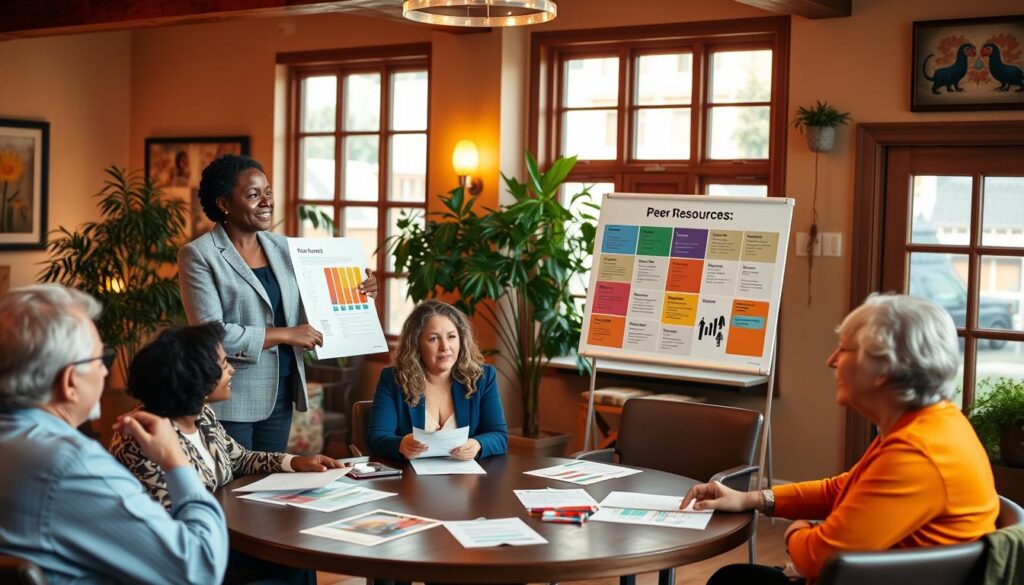
Peer support goes beyond just emotional support. It becomes a precise tool for finding solutions. The key question is not just about feelings but about who helped in similar situations.
Effective groups become hubs for practical help. They offer educational materials that are more than just pamphlets. They also connect families with local services based on personal experiences.
For example, a peer support network might recommend a lawyer who truly understands special education. This is much more valuable than a generic list from a government directory.
This field-tested advice is the heart of mutual aid. It’s like having a guide who has walked the path you’re on. The advice comes from people who have been in your shoes.
Let’s look at the logistics. Organizations like NAMI provide tools for finding support groups. These tools are more than directories; they’re the foundation for a support network. When no group exists, they offer a blueprint for starting one.
The results are impressive. Groups focus on finding real solutions, not just talking about problems:
- “This local charity helped with our utility bill when we were drowning in medical debt.”
- “Here’s the therapist who gets it, and she offers a sliding scale.”
- “Avoid that school district’s special ed department—try this advocate instead.”
This detailed matching helps with needs that social services might miss. Peer support finds specific solutions, like a landlord who understands anxiety disorders.
The efficiency is amazing. Mutual aid makes it easier to find help, unlike bureaucratic systems. Information flows through trust, not forms.
This turns the group into an active support system. Members gather and share important information. The collective wisdom grows, updated with real experiences.
The outcome is a support system that empowers you to overcome challenges. It’s like having a coach with a playbook based on real games.
This completes the cycle of mutual aid. Emotional support gives you the courage to act. Actionable intelligence provides the means. Together, they lead to solutions, not just sympathy.
Community Partnerships
Let’s face it: no self-help group can grow alone. Isolation hinders growth for both individuals and groups. The idea of a group meeting in secret is a path to stagnation, not progress.
Real strength comes when your peer support group connects with the community. Think of your group as a key part of a big network. Alone, you offer empathy and shared experiences. Together, you unlock resources, expertise, and the chance for real change.
Start by using what you already have: your group’s credibility. A self-help group is a trusted audience. Schools, community centers, and local nonprofits want to reach engaged listeners who might use their services.
This creates a win-win situation. Invite a local mental health agency to speak at your meetings. They share their knowledge, and you get valuable insights for your members. Need a meeting space? Approach a library or community center. They provide the space, and you bring the people.
Resource fairs are a great way to showcase your group’s impact. Turn a church hall or school gym into a hub for community resources. Your peer support group is the host, connecting people with housing, legal aid, employment services, and healthcare.
At these fairs, your members can access many services in one place. This boosts your group’s value from just providing support to being a gateway to resources. This approach aligns with research on peer support effectiveness that shows the importance of integration with formal services.
But partnerships need clear agreements, even if they’re just verbal. What each party brings to the table and the boundaries are key. A guest speaker gets 20 minutes, not a long sales pitch. The library gets credit in your materials.
Turning from a small self-help group to a community influencer takes effort. You need to build bridges. Know your local ecosystem, the players, and the gaps in services. Where does your peer support fit in?
This creates a strong network. If one resource is gone, others can help. Your members see themselves as part of a larger support web. This is the magic of community partnerships: turning vulnerability into power.
Measuring Success
Measuring the success of a mutual aid network isn’t as simple as counting heads in a Zoom room. We’re dealing with things that can’t be easily measured. How do you put a number on hope? Can you metricize the relief of feeling less alone?
Old methods like tracking attendance and collecting feedback forms don’t cut it. It’s like judging a novel by its page count. Real success in these areas is more complex and interesting.
Research from programs like Now & Next shows the real measure of success. They found that families keep using the program’s tools years after it ends. This isn’t just about completing a program; it’s about changing minds.
The real metric is the shift from “experts know best” to “we’ve got this.” This is where hope and empowerment create a positive cycle. Success in mutual aid is more like a journey than a certificate.
It’s about parents becoming confident leaders. It’s about families using strategies from their self-help group to get important school accommodations. These are the victories that spread.
So, how do you prove it? You build a case with a mix of evidence. You need both heart and head.
- The Anecdotal & Qualitative: Powerful, specific stories of personal transformation. The parent who says, “This group helped me find my voice again.”
- The Longitudinal & Behavioral: Data showing sustained use of learned tools and strategies over months and years.
- The Psychological & Emotional: Measured reductions in caregiver stress, anxiety, and feelings of isolation.
- The Participatory Evolution: Tracking how many members move from receiving support to providing it—the very engine of mutual aid.
- The Ripple Effect: Documenting how advocacy and confidence spill over into other areas of life, like healthcare or workplace negotiations.
This mosaic is your strong argument. It shows that these models create lasting change. It moves the conversation from “Did people like it?” to “How did it fundamentally alter their capacity to navigate their world?” When you can point to both the data on reduced stress and the story of the parent who became a community leader, you’re not just running a self-help group. You’re documenting a quiet revolution.
Stories of Impact
When “I felt alone” turns into “we figured it out together,” that’s the magic of mutual aid. Data shows the structure, but real stories tell the tale. Let’s hear those stories.
A NAMI member said, “The most beneficial thing for me was that I am not alone.” It’s more than just feeling better. It’s about seeing things differently.
Being alone makes you think your problems are yours alone. But being part of a community shows your struggles are shared. This change from “my problem” to “our situation” gives you power. It turns shame into something stronger.
There’s also the practical help. Someone else mentioned getting useful advice from the group. This isn’t just advice. It’s sharing knowledge.
When things are complicated, like healthcare or education, official advice can be hard to understand. Peer support helps make sense of it all. The best guide is someone who has already found their way.
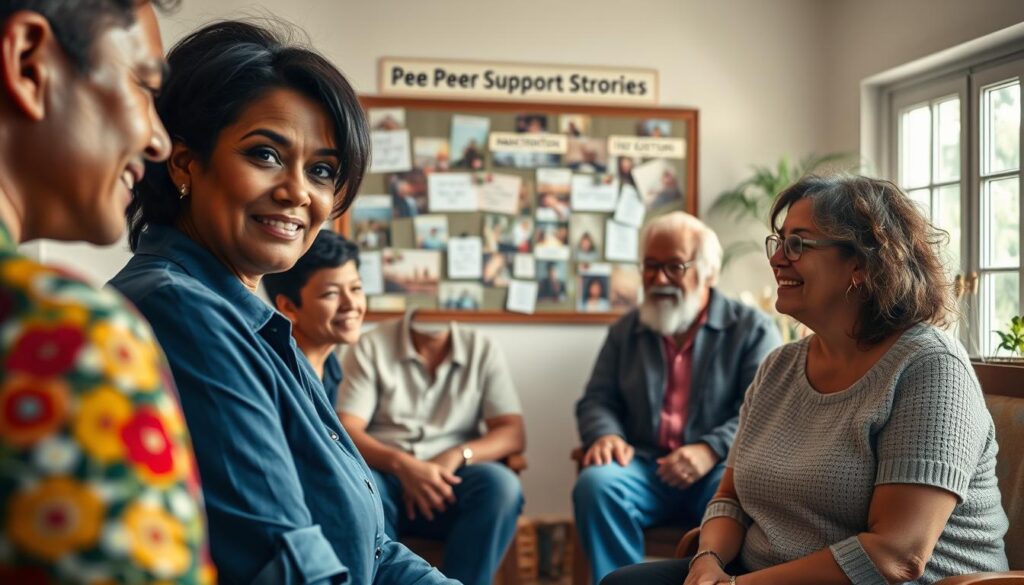
This exchange has a big impact. People gain confidence that helps others. A parent who learns to advocate for their child helps others too.
Knowledge used to be for “experts” only. But mutual aid changes that. It turns people from receivers to creators of solutions.
Here’s how it changes:
- Stage 1: Isolation – “This is my private burden.”
- Stage 2: Connection – “Others get it. I’m not crazy.”
- Stage 3: Knowledge Exchange – “Here’s what worked for me.”
- Stage 4: Agency – “We can navigate this system.”
- Stage 5: Advocacy – “Let me help you, too.”
This isn’t just a group hug. It’s a flow of knowledge. Each story shows the power of peer support. It proves that the person next to you can be your greatest resource.
The real change? It’s when people see themselves as part of a community, not broken. That’s when mutual aid becomes a way of life.
Challenges & Solutions
If you think of a self-help group as a circle of calm, enlightened people, think again. Real peer support is messy and human. It’s the chaos that makes the magic happen, thanks to the rules we set up.
Groups can fall into despair if they share too much trauma. One person might dominate the conversation, turning it into their show. And then there’s the person who gives bad health advice, thinking they’re right because they Googled it.
Facilitators often get burned out. It’s ironic because they need help too. Without support, they become exhausted, and the group’s energy drops. Simple things like finding a space and keeping people coming are big challenges.
To build a strong system, we don’t aim for perfection. Instead, we focus on being prepared. The key is in setting up a good structure, not expecting everyone to be perfect.
| The Challenge | Why It Happens | The Pragmatic Fix |
|---|---|---|
| The Dominator | Unprocessed need for control or validation can override group etiquette. | Establish a “shared airtime” rule in the group agreement. Use a talking object. Co-facilitators can gently redirect: “Thank you, Sam. Let’s hear from someone who hasn’t spoken yet.” |
| Misinformation & Advice-Giving | The desire to “fix” others’ problems is strong, but personal experience isn’t professional expertise. | Ground rules must state: “We share experience, not medical advice.” Facilitators can model this language: “What worked for me was… but please consult your doctor.” |
| Facilitator Burnout | Emotional labor is real. Carrying the group’s weight alone is unsustainable. | Implement a co-facilitation model. Create a facilitator support pod for debriefing. Mandate regular breaks. This isn’t a luxury; it’s maintenance. |
| Confidentiality Concerns | Trust is fragile. A single offhand comment outside the group can shatter it. | The group agreement must be read aloud each meeting, with a clear confidentiality clause. Discuss what “what’s said here, stays here” actually means in the age of social media. |
Having a mental health professional ready to help is key. A strong peer support system knows its limits. When someone needs more help than the group can offer, a quick referral is the best thing to do.
Think of these rules as safety measures on a dangerous road. They don’t ruin the journey but keep you safe. A self-help group that talks about its challenges is stronger than one that hides them. The mess is part of the journey. The plan helps you clean up and move forward together.
Understanding Mutual Aid and Self-Help Groups
Mutual aid and self-help groups are essential for building a supportive community. These groups provide a space for individuals to share their experiences and find solace in knowing they are not alone. By fostering a sense of belonging and connection, these groups empower individuals to overcome challenges and achieve personal growth.
Within these groups, members can find a safe environment to express their feelings and receive support from others who have faced similar struggles. This shared understanding creates a sense of solidarity and encourages individuals to support one another in their journey towards healing and recovery.
By actively participating in mutual aid and self-help groups, individuals can develop a stronger sense of community and foster meaningful connections. These connections are built on trust, empathy, and understanding, creating a supportive network that can provide ongoing support and encouragement.
Whether it’s through online forums, local support groups, or community organizations, there are numerous ways to find and engage with mutual aid and self-help groups. By exploring these options, individuals can tap into a wealth of resources and find the support they need to navigate life’s challenges.
Remember, mutual aid and self-help groups are not just about receiving support; they are also about giving back. By actively contributing to these groups, individuals can help others find solace and support, creating a ripple effect of kindness and compassion within their community.
So, if you’re looking for a supportive community and a sense of belonging, consider exploring mutual aid and self-help groups. These organizations offer a safe space for individuals to connect, share their experiences, and find the support they need to thrive.
Benefits of Mutual Aid and Self-Help Groups:
- Find solace and support from others who understand your struggles
- Develop a sense of belonging and connection within a supportive community
- Share experiences and gain valuable insights from others
- Build meaningful connections based on trust, empathy, and understanding
- Find resources and support to navigate life’s challenges
- Contribute to the well-being of others and create a ripple effect of kindness
Expansion Tips for Communities
You’ve seen the data and felt the shift. Now, it’s time to build your own local node of this quiet revolution. Imagine starting a band, but with empathy as the instrument and library community rooms as the venues.
First, find your founding members. Look for that one colleague who understands. Or your neighbor who’s been quietly struggling. Your local NAMI Affiliate is a great place to start, as they can connect you with others eager to form a peer support group. Don’t wait for an official invitation.
Next, find your venue. Public libraries often have free meeting rooms. Community centers, faith-based spaces, or even a quiet corner in a local café can work. The key is to make it easy for people to attend.
Use your networks to grow. Schools, online forums, and local clinics are full of people who might join. This is how movements like Now & Next expand. They tap into the power of shared experiences.
Your plan is straightforward. Start small and be consistent. Let the group’s needs shape its direction. It’s not about perfection. It’s about creating a mutual aid network that can grow and last.
The real magic happens when your local self-help group becomes self-sustaining. It’s a powerful form of hope—building connections from the ground up, one story at a time.