Men are nearly four times more likely to die by suicide than women. This is a shocking fact. We track everything from steps to stock portfolios but ignore male isolation.
This isn’t just about feeling sad sometimes. It’s about a system where anger hides despair. Irritability, fatigue, and substance misuse often hide deeper emotional pain. A study shows these are big barriers to seeking help.
The idea of the lone cowboy isn’t heroic. It’s a path to ruin. We’ve valued being tough over talking about feelings.
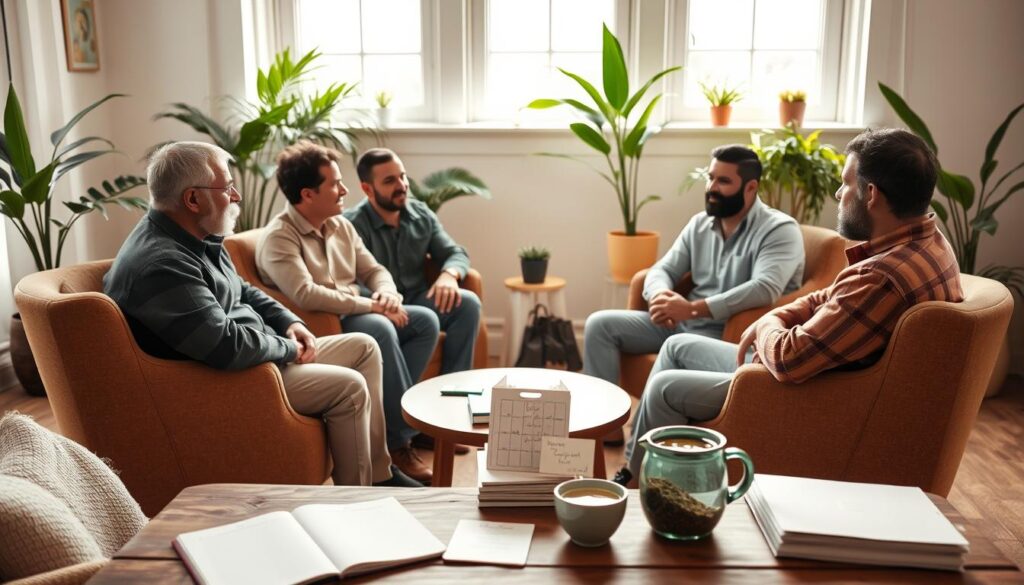
The real act isn’t staying silent. It’s about connecting with others. Think of it as a place to share feelings and survive. The goal is to grow stronger together.
Getting this is the first step to change the talk about men’s mental health. It’s not giving up. It’s a smart move.
Common Barriers
The cultural script about masculinity is like a bad action movie. The hero suffers silently for 90 minutes without seeking help. This script comes from the “Man Up” complex, mixing stoicism with strength and seeing vulnerability as a flaw.
Men are often told to “just deal with it” when they’re upset. This isn’t advice; it’s emotional austerity. It tells them discussing mental health is a sign of weakness.
Men share their stories looking for validation and empathy. They want to break free from shame and guilt. But, the culture sees asking for help as a flaw, not a strength.
The myth that ‘real men’ don’t ask for help is a collective delusion. We’ve made the silent type seem strong, but it’s actually emotional ignorance. This isn’t strength; it’s a lack of emotional understanding.
Data shows men’s mental health issues aren’t due to weakness. They come from a system that makes basic human needs seem wrong. Wanting connection is seen as neediness, seeking understanding as oversharing, and needing support as dependency.
This script is outdated and harmful. Admitting struggles feels like a betrayal of an unwritten code. The shame and guilt that follow are not personal failures but flaws in our view of masculinity.
The good news is we can change this script. We can choose to break free from this performance. Seeing these barriers as collective delusions, not personal weaknesses, is the first step to true strength. This strength builds connection, not isolation.
Types of Men’s Groups
Men’s groups come in many forms, from structured seminars to online forums. Finding the right one is about what you learn best, not being tough. Are you into workshops, following campaigns, or online discussions?
Structured groups, like “Strength with Heart,” offer expert-led sessions. Led by professionals, these groups focus on emotional growth. They provide a clear path and peer support within a set plan. It’s perfect for those who like a plan.
Public health efforts, like “Man Therapy,” use humor to talk about mental health. It’s not a group you join but a cultural shift you see. It makes seeking help seem normal, not scary.
Online forums offer a space for honest talks. You can share fears or doubts anytime. But, the advice quality varies, making it a double-edged sword for informal peer support.
| Group Type | Vibe & Approach | Best For | Notable Example |
|---|---|---|---|
| Facilitator-Led Workshop | Structured, curriculum-based, guided by a therapist or coach. Focus on skill-building. | The analytical learner who values evidence-based frameworks and progressive goals. | Strength with Heart groups |
| Public Health Campaign | Broad, destigmatizing, uses media & humor. A gateway to resources, not a meeting. | Men early in their journey, seeking normalized information before committing to a group. | Man Therapy platform |
| Peer-Led Support Circle | Organic, shared leadership, often topic-focused. Relies on group wisdom and shared experience. | Those seeking mutual understanding and camaraderie without a formal “teacher.” | Local men’s circles, book clubs |
| Online Community/Forum | Anonymous, asynchronous, 24/7 access. High variability in advice quality. | The night owl, the geographically isolated, or someone testing the waters with total privacy. | Various subreddits, dedicated mental health forums |
A study in PMC shows the value of group cohesion and guidance. This doesn’t mean online or organic groups are bad. It just means know what you’re getting into.
It’s not about finding the “best” group. It’s about finding the right fit for you. Do you need a structured seminar, a cultural push, a community, or an online space? Your group is out there; you just need to find it.
Tools & Activities Encouraging Openness
Men often say they want to talk about their feelings, but it’s hard to start. How do you go from thinking “I should talk” to actually talking on a random Tuesday?
Structure is the answer. It’s like having a GPS for your feelings. Without it, you’re lost.
Digital therapists can help. Programs like Calm Health’s “Decoding Masculinity & Mental Health” are more than just apps. They help change your thinking. For example, listening to “The Strength of Being Vulnerable” during your commute can change how you see emotions.
These sessions aren’t just for listening. They help you change your mind. Sessions like “Dealing with Anger” or “Going Easy on Yourself is Hard Work,” make it easier to talk about feelings.
There’s also a tool to check how you’re feeling. The Calm Health screening uses tests like the PHQ-9 and GAD-7. It’s not about getting a label. It’s about knowing where you start.
Think of it like an emotional check-up before a long journey. Knowing your starting point helps manage your men’s mental health. It moves from “I feel off” to “My anxiety score suggests X.”
But, what works for one man might not work for another. It’s important to have choices.
| Tool / Activity | Format | Best For | Time Commitment |
|---|---|---|---|
| Guided Audio Programs (e.g., Calm Health) | Digital / App-Based | The introvert, the commuter, the guy who needs private exploration first | 10-20 min per session |
| Standardized Screening (PHQ-9, GAD-7) | Online Questionnaire | Establishing a objective baseline for mood or anxiety | 5-7 minutes monthly |
| Structured Group Prompts | In-person or virtual circle | Men who thrive on shared experience and dialogue | 60-90 min weekly |
| Focused Journaling Exercises | Written / Digital Notes | Processing specific events or practicing gratitude | 10-15 min daily |
| Activity-Based Discussion (Walk & Talk) | Physical movement + conversation | Those who find side-by-side conversation easier than face-to-face | 30-60 min weekly |
The table isn’t just a menu. It’s a permission slip. It shows that taking care of men’s mental health is doable in small steps.
Maybe you start with a 7-minute screening. Or listen to a module on vulnerability while doing chores. The goal is to make it feel like maintenance, not therapy.
This changes everything. Talking openly is no longer a test. It’s a skill you can practice with the right tools. The aim is to make it easy, one tool at a time.
Success Stories
Let’s talk about proof that works. Not just numbers, but the human sigh of relief when someone else understands.
The most powerful data in men’s wellness isn’t always numbers. It’s the story of a guy who, after a lifetime of struggle, says, “I don’t think I’m okay.” The response that changes everything isn’t advice. It’s the echoed, “Me too.” That’s the moment the dam breaks.
This search for validation and relief from shame finds its answer in shared experience. When a peer says, “I’ve been there,” it carries a credibility no textbook can match. This is the core of effective peer support.
What does a “success story” actually look like here? It’s rarely a Hollywood ending.
- It’s the relief of de-isolation: Realizing your internal monologue isn’t a unique tragedy, but a common script.
- It’s the validation of feeling: Hearing that your guilt or anxiety isn’t a personal failure, but a human response.
- It’s the guidance that sticks: Advice from someone who’s navigated the same fog is a map, not just a compass.
Celebrities and athletes opening up help normalize the conversation, sure. But the real normalization happens in living rooms and community centers. It happens when everyday role models—the other men in the group—model vulnerability.
This is where peer support transitions from concept to catalyst. The perceived risk of opening up is consistently outweighed by the profound reward of not being alone in your own head. These stories are living proof. They demonstrate that connection is often the first and most critical step toward any other form of progress.
The success isn’t just in “feeling better.” It’s in building a new reference point. The next time a challenge hits, that internal voice of shame has to compete with the memory of a chorus saying, “We get it.” That’s the real, enduring win.
Involving Fathers/Grandfathers
What if the strongest thing a father can build isn’t a career, but a new emotional vocabulary for his son? The conversation about men’s support stretches vertically, through generations. It’s not just about your peers. It’s about the code you inherited.
For decades, the manual on fatherhood was simple: provide, protect, persevere in silence. Love was demonstrated through action, not articulation. Talking about fear or doubt was like admitting a structural flaw in the family foundation. Many of us grew up with this script.
Involving dads and grandads today isn’t about staging an intervention. It’s about a quiet, powerful reframe. You’re not rejecting their legacy. You’re expanding it. You’re saying, “The work ethic you gave me is priceless. Now, let’s talk about the toll it can take.” This is the deep work of healing the chain by becoming the new link.
Picture this: a son invites his father to a casual men’s group meet-up. Not as a patient, but as a sage. The older man witnesses his son being vulnerable, supported, unbroken by the very pressures he himself endured alone. The effect is profound. It doesn’t just help the son. It can absolve the father of a lifetime of unspoken loneliness. It proves that strength and openness aren’t opposites.
The shift is from being an emotional Fort Knox to being a connected, adaptable human. Research shows that a father’s mental health is linked to his children’s development and family health. Engaging older generations in a new dialogue about mental health can debug the family code for everyone.
Here’s a look at how the narrative is changing:
| Aspect | Traditional Fatherhood Script | Reframed Fatherhood Legacy |
|---|---|---|
| Core Duty | Sole financial provider | Emotional co-regulator |
| Strength Model | Stoic silence, enduring alone | Adaptable resilience, seeking connection |
| Love Expression | Through action and provision | Through dialogue and permission to feel |
| Inheritance | A work ethic and material security | A work ethic and tools for emotional security |
| Goal for Sons | To be “stronger” (more independent) | To be healthier (more integrated) |
This isn’t about blame. It’s about upgrade. When a grandfather sees his grandson navigate stress with support instead of stoicism, he doesn’t see failure. He sees evolution. He sees a version of strength he wasn’t allowed to access.
Ultimately, involving the older generation transforms fatherhood from a solitary burden into a shared, evolving journey. It closes the loop. It tells the old guard, “Your struggle wasn’t in vain. It’s the foundation. Now, watch us build something even more durable on top of it.” The chain gets stronger, link by link.
Online Options
Online support is like choosing between a loud bar and a quiet therapist’s office. Both have their uses, but you need to know what you’re getting into. The internet now offers many ways for men to connect, from quick chats to serious programs.
The peer support model on forums is like a digital stress relief. It’s where you can share your worries at 2 AM. These spaces offer quick comfort, knowing you’re not alone. But, they can also be a wild place for emotional support.
Studies show these forums often attract men who feel hopeless. They can make feelings of despair worse. It’s like trying to fix a broken arm with a Reddit thread.
On the other hand, programs like Calm Health offer something different. They provide privacy, expert advice, and proven methods. You can access them on your phone or computer, keeping your feelings private.
The table below compares these options. It shows what each does well and what it lacks.
| Platform Type | Access & Privacy | Evidence Base | Best For |
|---|---|---|---|
| Anonymous Forums | 24/7, completely anonymous | User anecdotes only | Immediate venting, finding common experiences |
| Social Media Groups | Semi-private, profile required | Mixed, often unmoderated | Community building around shared interests |
| Structured Apps (Calm Health) | Private, clinical confidentiality | Evidence-based protocols | Systematic progress, professional guidance |
| Teletherapy Services | Secure, HIPAA-compliant | Licensed professional care | Diagnosis, treatment plans, crisis management |
Forums are fast and private but not always reliable. Structured programs are more reliable but less spontaneous. The best strategy is to use both wisely.

Use forums as your midnight confessional. They’re good for quick relief. Then, use structured programs for real change in the morning. This way, you get both immediate comfort and long-term help.
The internet hasn’t replaced face-to-face support; it’s added to it. You need to choose the right tool for your needs. Forums are good for quick reassurance, while structured programs offer a clear path forward.
Quality peer support, online or in person, connects us and helps us feel less alone. The internet can be a barrier or a bridge. Pick platforms that help you connect with others safely and effectively.
Integrating Movement & Activity
Think about the last time you saw a group of guys really connect. They weren’t sitting in a circle holding hands. They were probably doing something—lifting weights, shooting hoops, hiking a trail.
The gym isn’t just a place to get swole; for many men, it’s a secular cathedral. It’s where we ritualize struggle, measure progress in tangible plates and pounds, and quite literally sweat out the demons. This instinct isn’t a bug in the male code; it’s a feature we can leverage for men’s mental health.
The genius of integrating movement isn’t about forcing deep chats during wind sprints. It’s about creating a side-door to vulnerability. When you’re physically spent, shoulder-to-shoulder with someone sharing the same grind, the emotional armor tends to unclench.
A shared physical challenge becomes a silent agreement: “We’re in this together.” That post-hike or game-day fatigue is where the real talk often slips out. It’s easier to mutter, “Man, I’ve been in a funk,” when you’re both endorphin-flooded and physically drained.
This approach speaks a language men are already fluent in: the language of the body. It bridges the gap between the physical grit we champion and the emotional resilience we’re learning to build. Research supports this link, showing that physical activity can be a powerful catalyst for psychological well-being by reducing stress and improving mood. We’re not swapping barbells for group therapy couches; we’re recognizing that the activity itself is the therapy session’s icebreaker.
Consider the formats:
- The Walking Meeting: A one-on-one catch-up that happens on a moving trail, not across a static desk.
- The Sport-as-Session: A basketball game where the post-game debrief about communication on the court naturally flows into communication off it.
- The Brotherhood of the Burn: A weightlifting group where spotting each other on a heavy bench press builds the same trust needed to spot emotional warning signs.
The goal is to make the work on men’s mental health feel less like work and more like a natural extension of camaraderie we already seek. The body moves, the mind follows. You build emotional reps alongside the physical ones. In the end, whether you’re counting miles or counting blessings, the path forward is always easier when you’re not walking it alone.
Community Partnerships
Real change happens when we talk about men’s wellbeing openly. It should be shouted from corporate rooftops and community centers. Community partnerships turn individual efforts into a big cultural movement.
Imagine if a man only heard about mental health from his therapist. That’s one voice. But when his employer, health department, and rec center all talk about it? That’s a loud chorus that beats out old masculinity norms.
Workplaces are key because men spend a lot of time there. Dr. Joel Axler says supporting men’s mental health is smart business. It’s not just charity.
Employers who listen to Axler are making a big difference. When fathers feel supported, they’re more present and less likely to quit. They make changes like:
- Normalizing therapy through EAP programs
- Creating peer support networks
- Offering flexible schedules for modern fatherhood
This isn’t just about being nice. It’s about keeping your best workers. The benefits go beyond saving on healthcare costs.
“Man Therapy” is another example of public health making a difference. It started in Colorado and now helps communities everywhere. Imagine seeing its bold messages in your community.
This approach meets men where they are. It uses humor and wisdom to get the message across. When a community uses this model, they’re saying, “We’re here to help without judgment.”
Local groups like the Mental Health Recovery Board in Ohio are also key. They offer real help to people in their area. It’s not just a national program; it’s local support.
These groups connect people with the help they need. They offer counseling, support groups, and resources for fatherhood challenges.
Partnerships amplify the message. When your boss talks about EAP, when your community health board runs a campaign, and when your gym has resources—your message gets stronger. It’s the stigma being fought on all sides.
Seeking help is no longer seen as a weakness. It’s a smart choice for a man who wants to be fully present. This is the growth of the men’s mental health movement.
Encouragement for First-Timers
Your lizard brain is on high alert, looking for social threats. It’s whispering doubts, just like before your first date or job interview. “What if it’s awkward?” Remember, it might be. But learning to ride a bike was awkward too.
Imagine walking into a CrossFit box for the first time. Everyone seems perfect until you see they started just like you. The real courage is in showing up, not being perfect.
This act changes how we see modern fatherhood. It’s not just about raising kids. It’s about growing as a person. You’re not broken; you’re just maintaining yourself.
Seeing vulnerability as courage changes everything. The people around you are on the same journey. They’re not judging you; they’re trying to figure things out too.
No need for big confessions. Just show up and listen. The door is open, and your future self is waiting.